
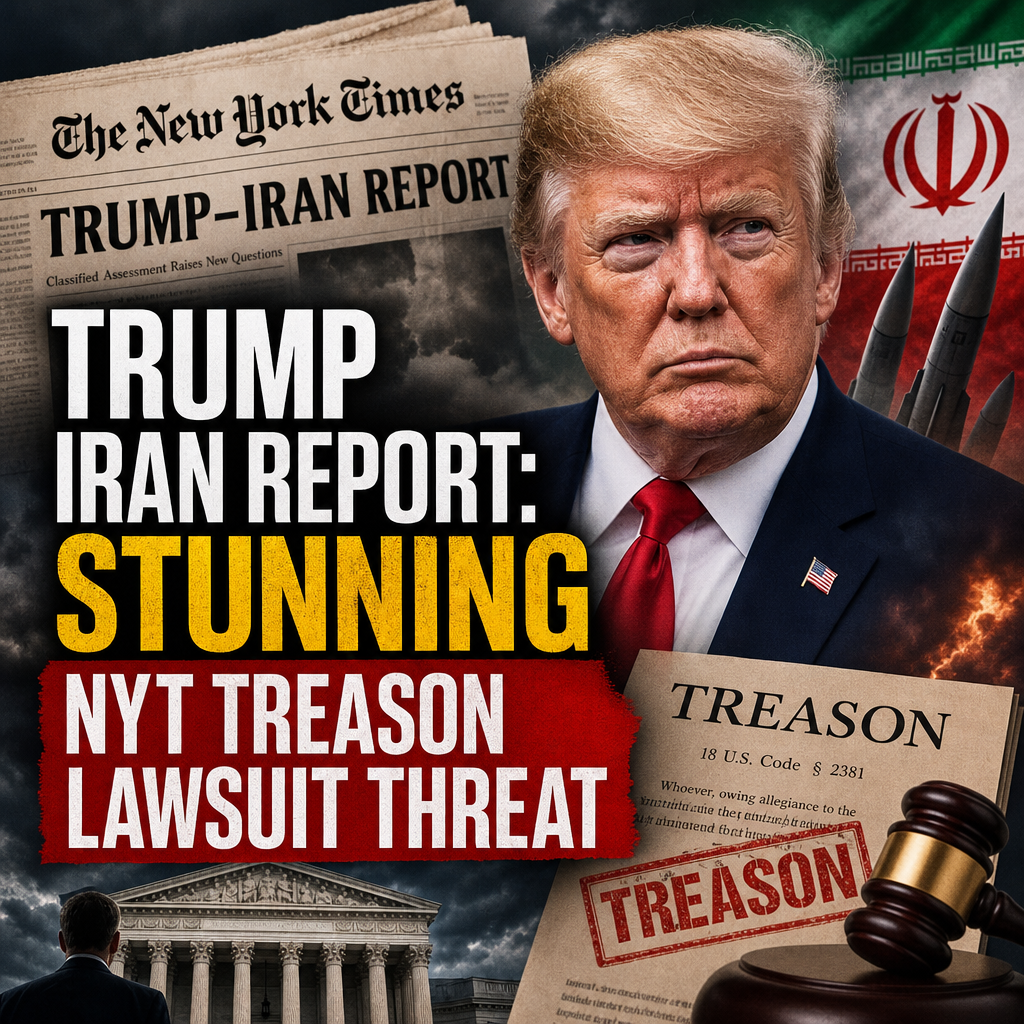
Trump Iran Report: Stunning NYT Treason Lawsuit Threat


Trump Iran Report coverage has become less about one newspaper story and more about the wider battle over truth, loyalty, and political pressure in an election-season media environment. What began as a dispute over reporting on U.S. strikes and intelligence assessments around Iran quickly escalated into a familiar Trump-era confrontation: the former president accusing major outlets of bad faith, while critics warned that the threat of legal retaliation is meant to chill scrutiny rather than correct errors.
The immediate flashpoint, reported widely across international outlets, was Donald Trump’s threat to sue The New York Times and accuse it of “treason” over its coverage of his handling of Iran-related issues. That language was not just inflammatory; it was strategic. It turned a debate over sourcing and national security into a loyalty test, framing journalism as an act of political sabotage. Supporters of Trump see that framing as a forceful response to what they view as a persistently hostile press. His opponents see it as another attempt to weaponize outrage against independent reporting.



Why the Trump Iran Report Became a Bigger Political Fight
The core dispute is not simply whether a report was favorable or unfavorable to Trump. It is about how national-security journalism is judged when the stakes involve Iran, military action, and intelligence claims that most readers cannot verify on their own.
In coverage from outlets such as RT and Sky News, the emphasis has been on the confrontation itself: Trump’s aggressive response, the legal threat, and the political theater surrounding it. That lens reflects one part of the story—namely, that Trump thrives on conflict with elite institutions and often turns controversy into momentum with his base. The New York Times, in this telling, is not merely a newspaper but a symbol of establishment opposition.




Al Jazeera’s broader reporting style on U.S. politics and the Middle East tends to place such confrontations in the context of regional instability and the long-running tension between Washington and Tehran. That perspective matters because the dispute is inseparable from the larger question of whether U.S. leaders are being transparent about military risks, diplomatic signals, and the consequences of escalation. Even if Trump’s complaint resonates politically, the underlying issue remains serious: if the public cannot trust official narratives on Iran, then any strike or threat of war becomes harder to assess democratically.
The fair conclusion is that both things can be true at once. Trump may genuinely believe he has been misrepresented. At the same time, threatening a “treason” case against a newspaper is not a normal response to disputed reporting. It is a high-voltage political move designed to delegitimize criticism.
The legal threat, and why it matters
A treason accusation is especially striking because treason is one of the most serious charges in U.S. law and has a narrow legal meaning. It is not a catch-all term for hostile journalism, critical analysis, or unfavorable coverage. That gap between rhetoric and law is important. When public figures use the language of treason loosely, they risk flattening the difference between dissent and disloyalty.
That distinction is not academic. In a polarized information environment, readers often encounter the same event through completely different moral frames:
– Trump allies may see a newspaper overstepping its role and trying to shape political outcomes.
– Trump critics may see an intimidation tactic aimed at discouraging accountability.
– Neutral observers may see yet another example of how media battles now function as political campaigning by other means.
Each reading contains a piece of the truth. But only one of them acknowledges the chilling effect such threats can have on investigative journalism. Even when a lawsuit is unlikely to succeed, the process itself can be costly, distracting, and intimidating for reporters and editors.
What the Sources Agree On — and Where They Diverge
Across the reporting landscape, there is broad agreement on one point: Trump’s response was unusually combative, even by his standards. There is also consensus that the episode is part of a long-running feud with major media organizations, especially The New York Times.
The differences emerge in emphasis.
RT’s framing: conflict as confirmation
RT’s coverage tends to highlight Trump’s grievance and the political force of his message. In that framing, the threat to sue is less about legal seriousness and more about exposing media bias. This resonates with audiences who already believe establishment outlets routinely distort conservative politics. The upside of that lens is that it reminds readers to question elite institutions. The downside is that it can normalize extreme rhetoric as if it were simply another legitimate form of accountability.
Sky News’ framing: the spectacle of escalation
Sky News’ international perspective often places the story within the broader spectacle of Trump’s communication style. That approach is useful because it separates the political drama from the legal substance. It treats the threat as part of a recognizable pattern: provoke, dominate the news cycle, then force opponents to respond on his terrain. In other words, the lawsuit threat becomes another instrument of political branding.
Al Jazeera’s framing: the regional stakes
Al Jazeera is more likely to connect the exchange to the Middle East dimension—namely, the gravity of any U.S.-Iran confrontation and the public’s need for clear, reliable information. From that angle, the story is not merely about press freedom or Trump’s personality. It is about decision-making under uncertainty, where misinformation or overstatement can have real-world consequences far beyond Washington.
The bigger question: is this about Iran, or about power?
The most useful way to read the Trump Iran Report episode is not to ask who was the loudest, but who controlled the narrative. Trump clearly tried to seize control by redefining the report as treasonous rather than disputable. That move is politically savvy because it forces journalists to defend not just their facts, but their legitimacy.
Yet the press also has a responsibility here. When outlets cover national-security issues, especially involving Iran, they must be precise, transparent about sourcing, and careful not to overstate certainty. In an era of leaks, anonymous officials, and rapid-fire social media spin, weak reporting can damage trust as much as political intimidation can.
The uneasy truth is that neither side enjoys a monopoly on credibility. Trump’s threat may be bluster, but bluster itself can shape public perception. The Times may be right to stand by its reporting, but every major outlet is also under pressure to prove that its scrutiny is grounded in evidence, not institutional reflex.
So the real takeaway is not that one side “won” the argument. It is that the argument reveals how fragile public trust has become around war, media, and power. If the Iran issue escalates again, the public will need more than outrage and counter-outrage. It will need journalism that is rigorous enough to resist intimidation—and transparent enough to deserve belief.

























